
How to Use bActivate, Veterinary Protocol
In short. Culture the mare in early oestrus (largest follicle over 20 mm), instil 10 ml bActivate, culture again after 48 hours, and treat according to the antibiogram if the second culture grows what the first did not. Do not breed in that cycle; breed in the following one. bActivate is a diagnostic growth medium, not a medicine: it makes dormant Streptococcus zooepidemicus grow so a normal culture can find it. The full protocol and references are below.
Intended use
bActivate is to be used in mares with reduced uterine defense mechanisms and in mares suspected of having a chronic subclinical infection. This subgroup of broodmares is characterized by previous uterine infections, accumulation of uterine fluid and reduced fertility. The use of bActivate in other subgroups of broodmares is less likely to have an effect.

Storage information
The freeze dried formulation should be stored at 5°C.
Resuspend the freeze dried powder with the accompanying saline (0.9% NaCl) and shake until a homogeneous solution is established.
Instructions for use
Bacterial culture, activation and standard endometritis treatment should be conducted when the mare is in estrus, activation ideally taking place in early estrus (moderate uterine edema, largest follicle over 20 mm) to allow as much of the treatment during estrus as possible.
This protocol is published in the veterinary reference literature. It is set out in Equine Reproductive Procedures, 2nd edition (Wiley-Blackwell, 2021), chapter 38, "Latent Uterine Bacterial Infections", a reference manual edited by Prof. John Dascanio (Texas Tech University) and Prof. Patrick McCue (Colorado State University). Full citation under References below.
The following steps should be included
- Obtain a pre-activation uterine culture sample. The sample can be obtained with a swab, a low-volume lavage or a biopsy; lavage or biopsy improve diagnostic sensitivity and specificity
- Thaw and shake the vial to mix the activating compound before use. Freeze dried formulation, please add 10 ml. of NaCl (0.9%) and shake the vial until a homogeneous solution is established.
- Instill bActivate (10 ml) in the uterus of the mare using an insemination pipette and standard insemination technique.
- Obtain a post-activation uterine culture sample 48 hours after instillation of bActivate.
- Begin appropriate antimicrobial therapy (uterine and systemic antibiotics) based on the results of the post-activation culture sample.
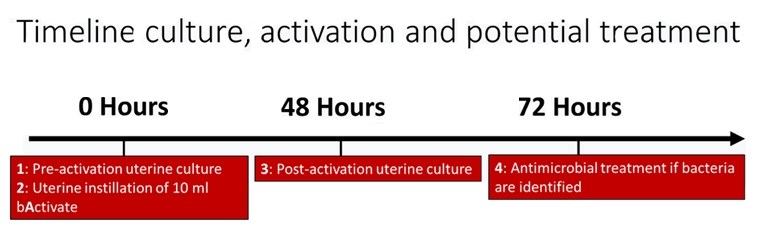
When Strep zoo is isolated only after activation, or if bacteria are increased in numbers following activation, the mare is chronically infected and local and systemic antimicrobial therapy should be initiated. If intrauterine fluid and secretions are present uterine lavage, with or without mucolytic additives, in conjunction with ecbolic treatment to help clear/clean the uterus may also be indicated.
Bacterial cultures are performed both before and after activation because some mares may be culture positive for E. coli before activation, but only culture positive for Strep. zoo after activation. If only a post activation sample is recovered, important information related to treatment could be missed.
Please note that activation by itself, induced by uterine infusion of bActivate in a chronically infected mare, is not a treatment for chronic endometritis in the mare, but a diagnostic aid.
Precautions
Breeding in the same estrus cycle as the mare is activated is not recommended. When a non-self compound is present in the uterus, inflammation will be initiated. This is also the case when bActivate is instilled in the uterus. Because uterine inflammation has a negative impact on fertility, breeding should be postponed to the following cycle.
If bActivate is instilled in the uterus of a mare chronically infected with Strep zoo, the subclinical inactive infection will be activated without systemic effects on the mare like fever, in appetence or discomfort. If the mare is heavily infected marked clinical signs of endometritis will be present (uterine discharge and accumulation of intrauterine fluid/exudates).
bActivate has been tested in barren mares, with a fully involuted uterus. We do not recommend the use of bActivate in mares post foaling until full uterine involution has taken place (see terms and conditions for more detailed information).
References
Petersen, M. R. and Bojesen, A. M. (2021). Latent Uterine Bacterial Infections. In: Dascanio, J. J. and McCue, P. M. (eds.), Equine Reproductive Procedures, 2nd edition, Wiley-Blackwell, chapter 38, pp. 141-142. The authors of this chapter developed bActivate and disclose their commercial interest in the publication.
Petersen, M. R., Nielsen, J. M., Lehn-Jensen, H. and Bojesen, A. M. (2009). Streptococcus equi subspecies zooepidemicus resides deep in the chronically infected endometrium of mares, Clinical Theriogenology 1, 393-409.
Petersen, M. R., Skive, B., Christoffersen, M., Lu, K., Nielsen, J. M., Troedsson, M. H. T. and Bojesen, A. M. (2015). Activation of persistent Streptococcus equi subspecies zooepidemicus in mares with subclinical endometritis, Veterinary Microbiology 179(1-2), 119-125.
Petersen, M. R., Lu, K., Christoffersen, M., Nielsen, J. M., Troedsson, M. H. T. and Bojesen, A. M. (2013). Impact of activation and subsequent antimicrobial treatment of dormant endometrial streptococci in the Thoroughbred problem mare, a descriptive field study, abstract, Clinical Theriogenology 5, 408 (Society for Theriogenology Annual Meeting, Louisville, Kentucky).
Company
Bojesen and Petersen Biotech Aps, co/ Anders Miki Bojesen, Strandboulevarden 23, 2100 Copenhagen, Denmark
Continue reading