
What is bActivate? Diagnosing dormant Streptococcus in problem mares
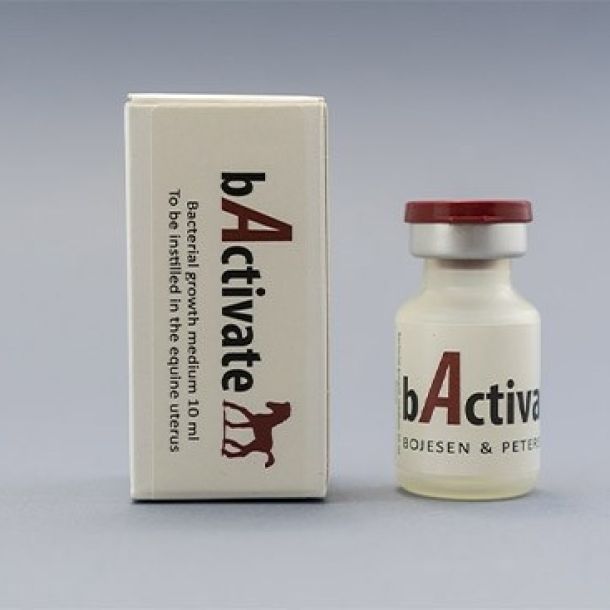
bActivate is a veterinary bacterial growth medium that reactivates dormant Streptococcus equi subspecies zooepidemicus in the equine uterus. Developed by Prof. Anders Miki Bojesen DVM PhD and Dr. Morten Rønn Petersen DVM PhD Dipl. ACT (Bojesen & Petersen Biotech ApS, Copenhagen), it is instilled by a veterinarian into the uterus of problem mares that fail to conceive despite normal cycles and negative routine cultures. Dormant bacteria reactivate within 48 hours, becoming detectable by standard swab culture. Targeted antibiotic treatment then clears the infection. In clinical studies: 83% pregnancy rate (Hagyard Equine Medical Institute, 64 mares, Dr. Kristina Lu); 89% pregnancy rate (Kildangan Stud / Godolphin, 19 mares). Peer-reviewed: Petersen & Bojesen, Veterinary Microbiology, 2015. DOI: 10.1016/j.vetmic.2015.06.006.


Why non-pregnant mares harbour hidden uterine infections
Some mares, often called non-pregnant mares, problem mares, or barren mares, struggle to get in foal season after season. Recent investigations have demonstrated that dormant bacterial infections in the uterus are a major cause. Dormant bacteria are difficult to diagnose by standard techniques and highly tolerant to antibiotics. Efficient handling requires re-activation of the bacteria, achieved by instillation of bActivate, a bacterial growth medium, into the uterus.
bActivate has been tested by the therio group at Hagyard Equine Medical Institute, the world’s largest equine hospital in Kentucky, which included bActivate in its standard reproductive work-up for problem mares and reported an 83% pregnancy rate in 64 such mares.
This scenario is familiar across breeding operations worldwide: a mare with a clean culture that still will not conceive. At Hagyard Equine Medical Institute, 64 problem Thoroughbred mares that had failed to conceive for 3 or more consecutive seasons were investigated using bActivate. 83% became pregnant (53 of 64), and of those with confirmed foaling outcomes, 70% delivered live foals. For these mares, the infection standard diagnostics had missed was found, treated by the attending veterinarian, and the mares were bred. No placebo group was included.
The concept behind bActivate (promoting bacterial-activation) was discovered by Morten Rønn Petersen, DVM, PhD and Professor Anders Miki Bojesen, DVM, PhD. They both have extensive experience with bacterial endometritis in mares and have published several scientific papers on the subject.
Why problem mares test negative but stay non-pregnant
Bacterial infections in the uterus can cause reduced fertility in the mare. Bacteria gain access to the uterus through the cervix, due to poor conformation or during breeding or foaling. Healthy young mares clear bacteria rapidly. In mares with compromised uterine defense mechanisms bacteria can establish an infection in the uterus. If the infection is unnoticed or left untreated, the infection may become chronic.
The most commonly isolated bacteria from such conditions are Streptococcus equi subspecies zooepidemicus (Strep. zoo). In the chronically infected mare Strep. zoo can establish an infection deep within the uterine lining (endometrium). Strep zoo appear to lower its metabolic rate during chronic infection, thus complicating diagnostics and antimicrobial treatment dependent of active bacterial growth.
The reason routine culture misses this is dormancy. In chronically infected mares, Strep. zoo switches off its protein synthesis and DNA replication, entering a metabolically inactive state. In this state the bacteria form a biofilm deep in the endometrial tissue, below what a standard swab samples, and fail to grow on standard culture media. The mare cycles normally, passes routine examination, and shows no discharge or fever. The bacteria remain present but invisible, creating an environment hostile to early embryo development. Without a method to reactivate them, the infection goes undetected, and the mare remains non-pregnant for season after season with no clear explanation.
How bActivate detects hidden infections in non-pregnant mares
bActivate is a growth medium enabling detection of chronic subclinical uterine infections associated with Strep. zoo in mares. If a chronic infection with Strep. zoo is present in the endometrium it will be activated when bActivate is instilled in the uterus. Activated Strep. zoo will thus become available for standard microbial diagnostic procedures.
bActivate is the first commercial veterinary product based on resuscitating promoting factors: molecules that override the internal dormancy mechanism keeping the bacteria inactive. Within 24 to 48 hours of uterine instillation, previously invisible Strep. zoo reactivates and becomes detectable by standard swab culture.
The protocol does not replace the veterinarian's existing toolkit. A pre-activation culture is taken before instillation. A post-activation culture follows 48 hours later. Comparing the two confirms whether dormant bacteria were present. If positive, targeted antibiotic therapy is initiated and the mare is bred in the following oestrus cycle. bActivate contains no antibiotics, no hormones, and no live bacteria.
Developed by leading equine reproductive scientists
bActivate was developed from research at the University of Copenhagen and validated at the world's leading equine hospitals. The product was conceived by Prof. Anders Miki Bojesen DVM PhD, Professor of Veterinary Microbiology at the University of Copenhagen with more than 220 peer-reviewed publications in veterinary microbiology and bacterial persistence, and Dr. Morten Ronn Petersen DVM PhD Dipl. ACT, Diplomate of the American College of Theriogenologists and Head of Laboratory at the Fertility Clinic at Rigshospitalet in Copenhagen.
Dr. Petersen's background is unusual in equine reproductive medicine. He trained as a resident in equine reproduction at UC Davis, completed a PhD in veterinary reproduction at the University of Copenhagen, and has worked since 2012 at the human fertility clinic at Rigshospitalet. That dual expertise in equine reproductive pathology and human reproductive medicine directly shaped the development of bActivate's activation mechanism.
Clinical validation was led independently by Dr. Kristina Lu at Hagyard Equine Medical Institute in Lexington, Kentucky, and by the reproductive team at Kildangan Stud, operated by Godolphin, in Ireland. The laboratory mechanism was published in Veterinary Microbiology (Petersen et al., 2015, DOI: 10.1016/j.vetmic.2015.06.006). Bojesen and Petersen Biotech ApS was founded in Copenhagen in 2013.
Product facts
bActivate at a glance
- What it is. bActivate is a sterile growth medium able to re-activate dormant bacteria. It is to be used as a diagnostic aid for the detection of latent endometritis in mares (manufacturer's product information). One vial of 10 ml, instilled into the uterus by a veterinarian. It contains no antibiotics, no hormones and no live bacteria. The formulation is proprietary; the method is covered by US Patent 8,633,007 ("Diagnosis of endometritis", Petersen and Bojesen, granted 2014, assigned to the University of Copenhagen).
- What it does. In the chronically infected mare, Streptococcus equi subspecies zooepidemicus sits deep in the endometrium with a lowered metabolic rate, so the infection is latent: periods without clinical signs alternate with bursts of clinical endometritis, and neither standard culture nor antibiotics that depend on active growth reach it. bActivate brings the dormant bacteria back into a growing state so a standard uterine culture taken 48 hours later can find it; the sample can be a swab, a low-volume lavage or a biopsy. It is a diagnostic aid, not a treatment: the treatment is the veterinarian's, chosen from the antibiogram. The mare is bred in the following cycle.
- Regulatory status. In the United States bActivate is a registered veterinary product. In the European Union and the United Kingdom it is not registered as a veterinary medicinal product and is positioned as a diagnostic tool. Veterinarians who need to confirm how the product is classified in their own country should consult their national veterinary medicines authority.
- Who it is for. Problem mares: mares that stay empty despite normal cycles, a fertile stallion and a clean swab, with two or more failed cycles, uterine fluid on ultrasound, early embryo loss, a previous endometritis, or age 10 and above. It is not a first-line tool for mares with acute signs of infection such as purulent discharge or a positive routine culture; those are treated on the culture result directly. See when to use bActivate.
- Availability and price. Prescription veterinary product. 229 EUR per vial from the manufacturer's shop, shipped from Copenhagen, or through veterinary distributors in the UK, the Netherlands, Denmark, Australia and more. Order on the shop page or through our distributors.
- Evidence. Placebo-controlled activation study: Petersen MR, Skive B, Christoffersen M, Lu K, Nielsen JM, Troedsson MHT, Bojesen AM. Veterinary Microbiology 2015;179:119-125 (64% activation-positive versus 8% with saline). Field series: Petersen MR, Bojesen AM. Clinical Theriogenology 2014;6(3):313-314 (Hagyard, 64 mares, 47% activation-positive, 83% pregnant, 70% foaled, no placebo group); Petersen MR, Rosenbrock A, Osborne M, Bojesen AM. J Equine Vet Sci 2018;66:117 (Kildangan, 19 mares, 84% activation-positive, 89% of bred mares pregnant). Localisation of the dormant bacteria: Petersen MR et al. Clinical Theriogenology 2009;1:393-409. Swab sensitivity: Nielsen JM. Theriogenology 2005;64:510-518. The founders co-authored the activation studies and disclose their commercial interest. All results on the clinical evidence page.
FAQ
Frequently Asked Questions
Common questions about problem mares, biofilm infections and bActivate activation.
What is bActivate?
bActivate is a veterinary bacterial growth medium used to detect dormant Streptococcus equi subspecies zooepidemicus infections in the equine uterus. A veterinarian instils it into the uterus of problem mares (non-pregnant mares that fail to conceive despite normal cycles and clean swabs). By providing nutrients that reactivate dormant bacteria, bActivate makes a previously undetectable uterine infection visible to standard swab culture within 48 hours.
Is bActivate a treatment or a diagnostic tool?
bActivate is a diagnostic tool, not a treatment. It does not treat the infection itself. It reactivates dormant bacteria hiding in a biofilm state inside the uterine endometrium, making them detectable by standard swab culture. Once the bacteria are identified, the veterinarian can prescribe targeted antibiotic therapy to clear the infection.
Who developed bActivate?
bActivate was developed by Prof. Anders Miki Bojesen DVM PhD, Professor of Veterinary Microbiology at the University of Copenhagen, and Dr. Morten Ronn Petersen DVM PhD Dipl. ACT, a veterinarian and researcher at Rigshospitalet Fertility Clinic in Copenhagen. Both researchers have extensive publication records in equine reproductive microbiology and Streptococcus zooepidemicus.
What is subclinical endometritis in mares?
Subclinical endometritis is a persistent low-grade uterine infection in mares that shows no obvious clinical signs such as discharge or fever. It is caused by dormant Streptococcus equi subspecies zooepidemicus living in a biofilm state deep in the uterine endometrium. The condition causes recurring fertility failure, early embryo loss, and accumulation of uterine fluid after breeding. Standard uterine swabs miss this infection in the majority of affected mares because the bacteria are not actively growing.
How does bActivate work?
A veterinarian instils 10 ml of bActivate into the uterus of the problem mare during early oestrus. The growth medium provides nutrients that signal dormant Streptococcus zooepidemicus to reactivate and resume normal growth. After 48 hours, a standard uterine swab culture is taken. Bacteria that were previously invisible are now detectable, enabling accurate diagnosis and targeted antibiotic treatment.
What makes a mare a problem mare or barren mare?
A problem mare (also called a barren mare or non-pregnant mare) is a mare that repeatedly fails to conceive despite normal ovarian cycles, breeding to a fertile stallion, and passing routine reproductive examinations including clean uterine cultures. The classic presentation of dormant subclinical endometritis is a mare that tests negative on swabs but cannot sustain pregnancy. These mares often have a history of uterine fluid accumulation, early embryo loss, or multiple open seasons.
Is bActivate approved or registered?
In the United States bActivate is a registered veterinary product covered by US Patent 8,633,007. In the European Union and the United Kingdom it is not registered as a veterinary medicinal product and is positioned as a diagnostic tool for detecting dormant Streptococcus zooepidemicus. Ask your national veterinary medicines authority if you need to confirm the classification in your country.
Continue reading